
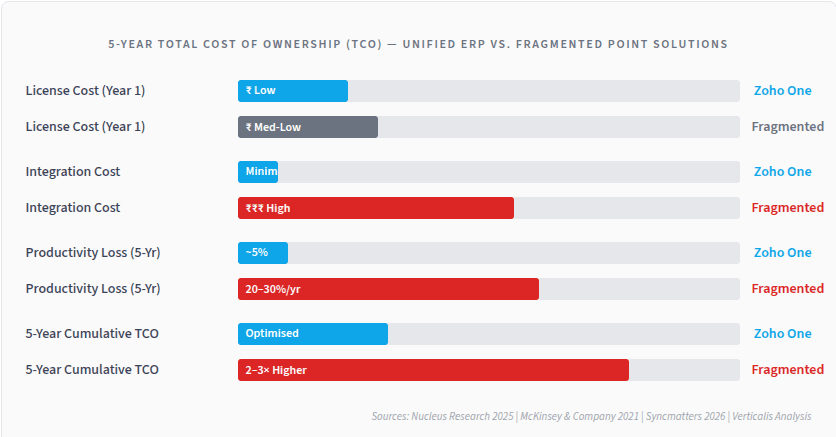
The most dangerous technology decision a business can make is the one that feels cheapest today. Short-term cost savings on fragmented, function-specific ERP tools routinely cost organizations 30% of annual revenue in productivity drag, data dissonance, and compounding inefficiency— a tax that grows invisibly until it becomes a competitive liability.
The Illusion of Cheap: Why Low-Cost ERPs Create High-Cost Problems
In boardrooms across India and globally, the technology procurement conversation tends to follow a predictable script. The CFO presents a budget constraint. The IT head pulls up a comparison matrix. The cheapest-per-seat option wins. And for the first 12 to 18 months, it feels like the right decision.
Then reality arrives—quietly, without a single system failure to point to. It arrives as the sales team spending an extra 40 minutes each morning reconciling data across two systems that do not speak to each other. It arrives as the finance department maintaining shadow spreadsheets because the accounting module does not integrate with the CRM. It arrives as a decision that should take two hours taking two days because there is no single source of truth.
You can edit text on your website by double clicking on a text box on your website. Alternatively, when you select a text box a settings menu will appear. your website by double clicking on a text box on your website. Alternatively, when you select a text box.
"The most expensive technology is the technology that appears cheap on day one."— A principle that has defined every failed digital transformation I have studied.
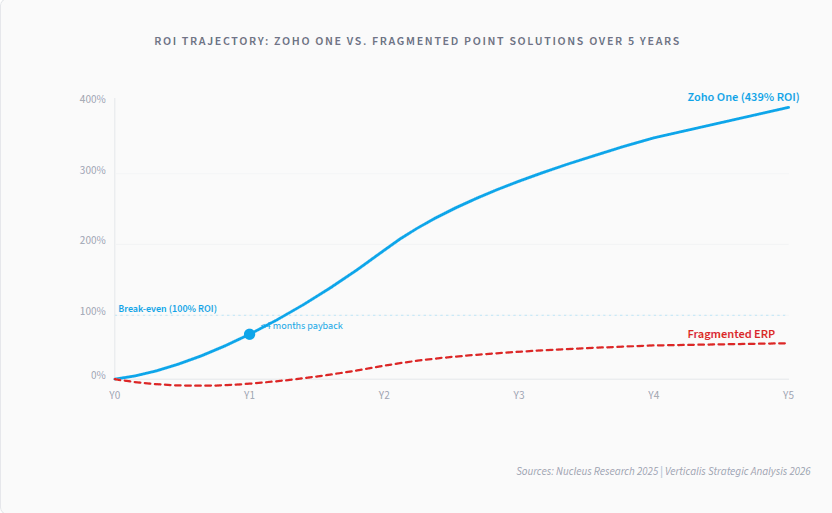
According to research from McKinsey & Company, reconciliation-heavy environments—those characterised by fragmented, function-specific ERP deployments—materially increase cost per transaction as organisations scale.[1] The inefficiency is not linear; it is exponential. As headcount grows, as product lines expand, as geographies multiply, each disconnected system multiplies the integration debt.
The mechanics of this loss are well-understood. Gartner confirms that fragmented technology environments reduce decision accuracy by delaying access to consistent, real-time data.[3] When your sales data lives in one system, your finance data in another, and your operations data in a third, the latency between event and insight becomes a competitive liability that compounds daily.
The Hidden Cost Iceberg: What You Do Not See When You Choose Cheap
Every technology procurement decision involves two prices: the visible price on the invoice and the invisible price that accrues over the life of the deployment. Function-specific ERPs and disconnected point solutions are iceberg investments—a small visible cost above the surface, and a catastrophic hidden mass below.
The Five Cost Categories of Fragmentation
⏱ Integration & Reconciliation Labour A 2024 study found businesses using disconnected legacy systems spent up to 30% more time reconciling financials compared to integrated cloud ERP users.[4] Staff become the integration layer—manually re-entering data between systems. | 📉 Opportunity Cost of Poor UI & Adoption Poor UI design in low-cost ERPs drives sub-optimal adoption. When systems are not intuitive, employees create workarounds—spreadsheets, WhatsApp groups, email chains—each of which becomes an uncontrolled data silo. | 🔧 Integration & Maintenance Overhead ERP cost overruns affect 57% of projects, often due to underestimated integration complexity.[5] Cheap platforms that lack native modules force expensive third-party integrations that require constant maintenance. |
📦 Scalability Walls Function-specific ERPs hit capability ceilings as businesses grow. Adding verticals—HR, analytics, e-commerce, helpdesk—requires procuring new vendors, creating new integration debt with no data inheritance from prior systems. | 🚫 Switching Costs & Data Migration Risk Migrating away from a deeply embedded point solution typically costs 3–5× the original implementation cost, plus 6–12 months of parallel-running risk, employee retraining, and data cleansing investment. | 📞 Support & Vendor Viability Risk Small ERP vendors providing function-specific tools often lack enterprise-grade SLAs, 24/7 support, and multi-year product roadmap visibility. A vendor discontinuation leaves businesses in emergency re-implementation with zero notice. |
The Unified Platform Imperative: Why Integration Is Not a Feature—It Is a Strategy
The fundamental question of enterprise technology is not "which application solves this problem?" but rather "which platform connects all my problems into a coherent, improvable system?" This distinction is not semantic. It is the difference between building a business and building a machine.
Consider the operational reality of a growth-stage Indian enterprise. Sales operates in one system. Finance reconciles in another. HR tracks headcount in a third. Operations manages delivery in a fourth. Each system represents a pocket of truth—accurate in isolation, misleading in combination. The CEO asking "what is our actual gross margin this quarter?" should not require a three-day cross-referencing exercise involving four departments.
"When your systems don't communicate, your people become the integration layer—and that is the most expensive middleware you will ever deploy."— Hiren Joshi, CXO, Verticalis Pvt. Ltd.
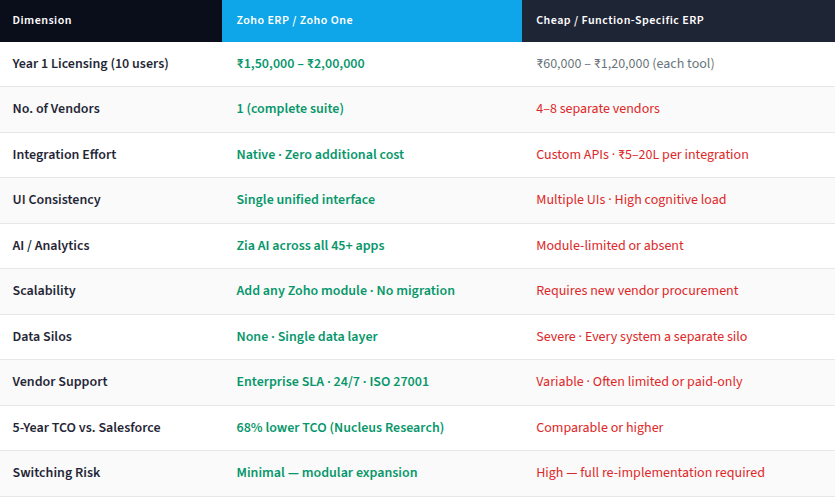
This is the unified platform imperative: a single operating system for business where every function—sales, finance, HR, operations, marketing, helpdesk, projects—runs on interconnected data, automated workflows, and a single AI layer. This is not a luxury reserved for enterprises. With Zoho One, it is accessible to Indian SMEs at ₹1,500 per user per month.
Zoho ERP & Zoho One: The Architecture of Long-Term Value
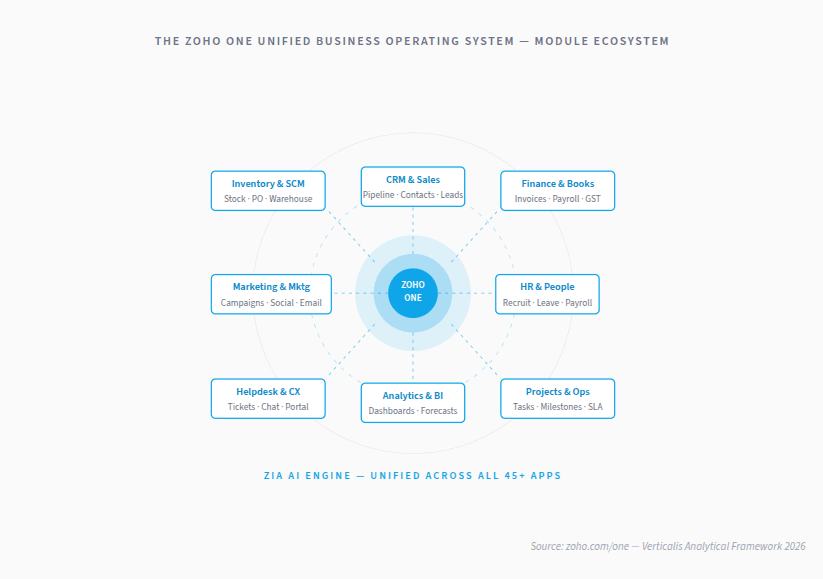
Zoho ERP is not a single product. It is an integrated business management architecture built on the Zoho One platform—a suite of 45+ enterprise-grade applications covering every business function from lead capture to financial close, from employee lifecycle to customer success.
Zoho One—described by Zoho as "the operating system for business"—fundamentally changes the economics of enterprise software by replacing 10 to 15 disparate subscriptions with a single, unified platform license. As of 2026, the All-Employee Plan in India starts at ₹1,500/user/month, delivering 45+ applications with native data flow between every module.
The Four Structural Advantages of Zoho's Architecture
🔗 Native Data Continuity Data flows natively between CRM, Books, People, Projects, Desk, and Analytics. A deal won in CRM automatically creates a project in Projects, raises an invoice in Books, and triggers an onboarding workflow in People—with zero manual intervention. | 🤖 Zia AI — One Intelligence Layer Unlike function-specific tools with siloed AI modules, Zia operates across the entire Zoho ecosystem—providing predictive analytics, anomaly detection, candidate matching, financial forecasting, and automated content generation in one unified intelligence layer. |
| 📈 Infinite Scalability Without Migration When your business adds a new function—e-commerce, inventory, employee helpdesk, payroll—you simply activate the corresponding Zoho module. No new vendor. No new integration project. No data migration. The same platform grows with you. | 🛡 Enterprise-Grade Security at SME Price Zoho's infrastructure is ISO 27001 certified, with India data residency available, AES-256 encryption at rest, TLS 1.3 in transit, GDPR & DPDPA 2023 compliance, and SOC 2 Type II certification—security architecture that would cost crores to replicate independently. |
ROI: The Numbers That Make the Case Irrefutable
The most rigorous independent analysis of Zoho's business impact comes from Nucleus Research, whose 2025 study across multiple organisation types produced findings that should permanently reframe how Indian business leaders think about ERP investment decisions.
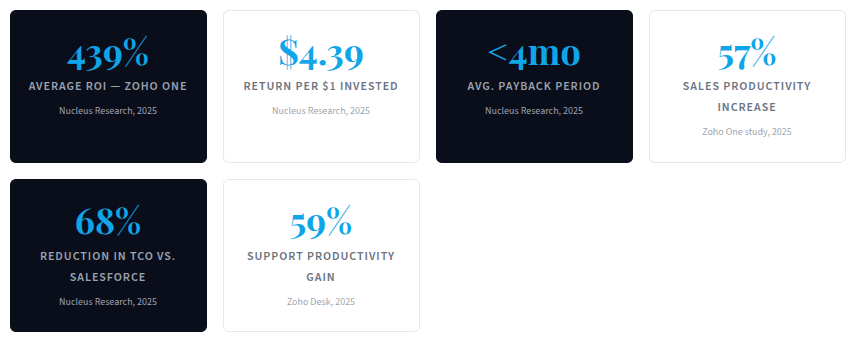
These are not aspirational projections. They are documented outcomes from verified Nucleus Research case studies. Let us decode what these numbers mean in the Indian business context:
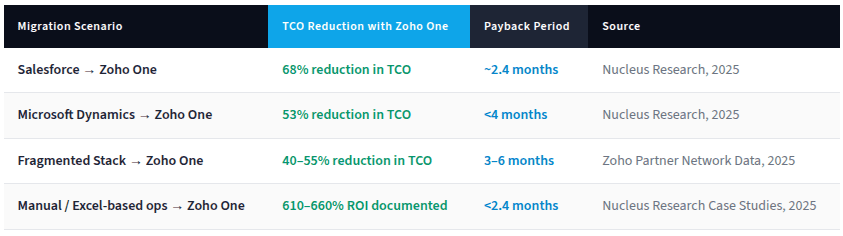
TCO Benchmark: The Migration Economics
Use Cases: Transformation in Practice
Theory is insufficient without evidence. The following use cases—drawn from Nucleus Research verified studies and Verticalis implementation experience—illustrate the compounding power of unified ERP automation versus fragmented point solutions.
Case 1: Equipment Rental Company — 610% ROI in 2.4 Months
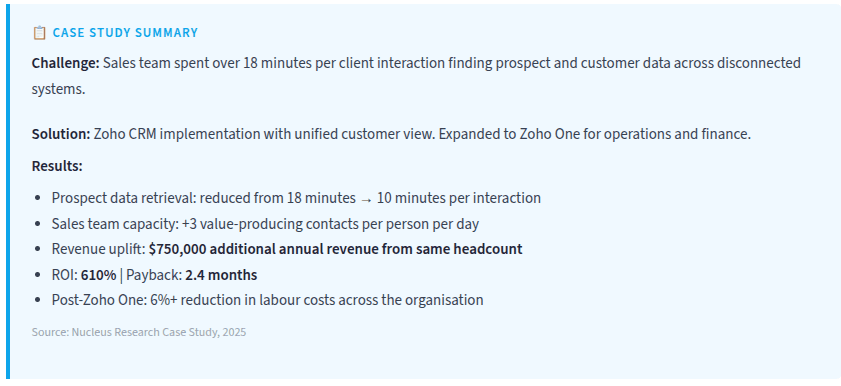
Case 2: Professional Services Firm — 660% ROI, Salesforce Migration
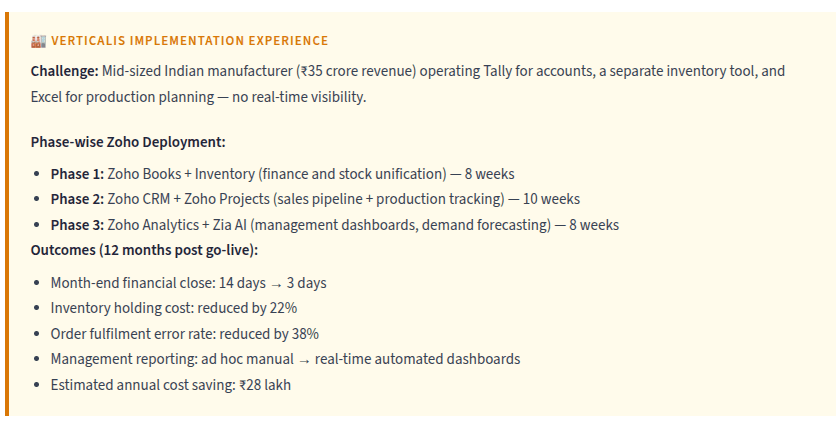
Case 3: Manufacturing SME — Inventory & Finance Integration (India Context)
Phase-Wise Strategy: Why Sequenced Implementation Is the Only Correct Approach
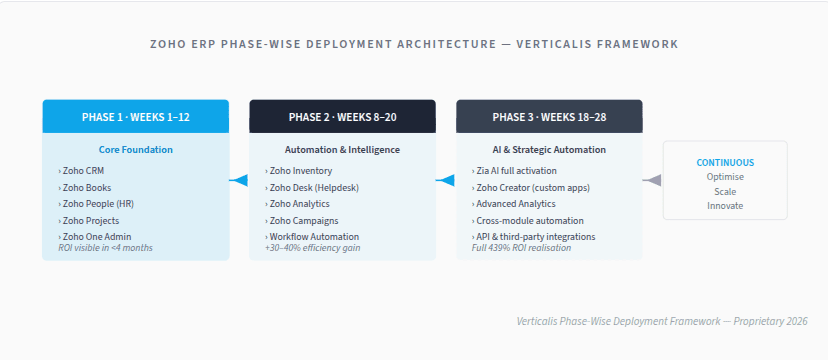
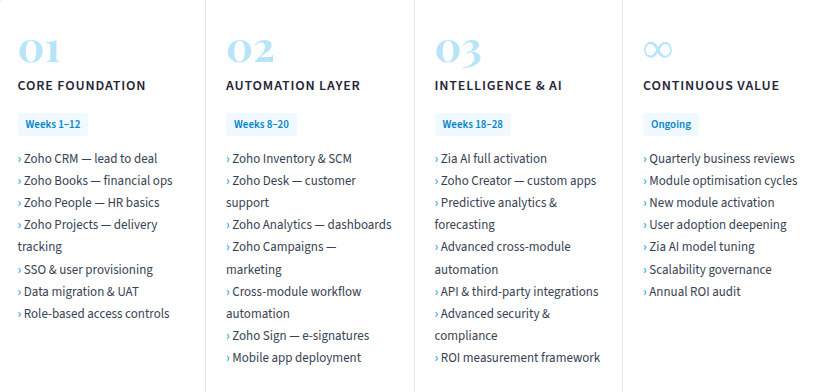
One of the most important strategic insights I can offer any business leader is this: a unified ERP strategy does not require a big-bang deployment. The very thing that makes Zoho One architecturally superior—its modularity—also makes it the ideal platform for a disciplined, phase-wise rollout that delivers value at every stage while building toward the complete automation vision.
The alternative—attempting to deploy every module simultaneously—is one of the leading causes of ERP implementation failure. The 2024 Panorama ERP Report found that the median ERP project costs $450,000, with 57% experiencing cost overruns, often due to scope complexity and change management challenges.[6] Phase-wise deployment with Verticalis eliminates this risk by controlling scope, building organisational capability progressively, and generating ROI that funds subsequent phases.
The Verticalis Difference: Managerial-Techno, Not Techno-Managerial
Every Zoho implementation partner in India can configure workflows and deploy modules. What most cannot do is answer the question that actually matters: how does this technology serve your business strategy?
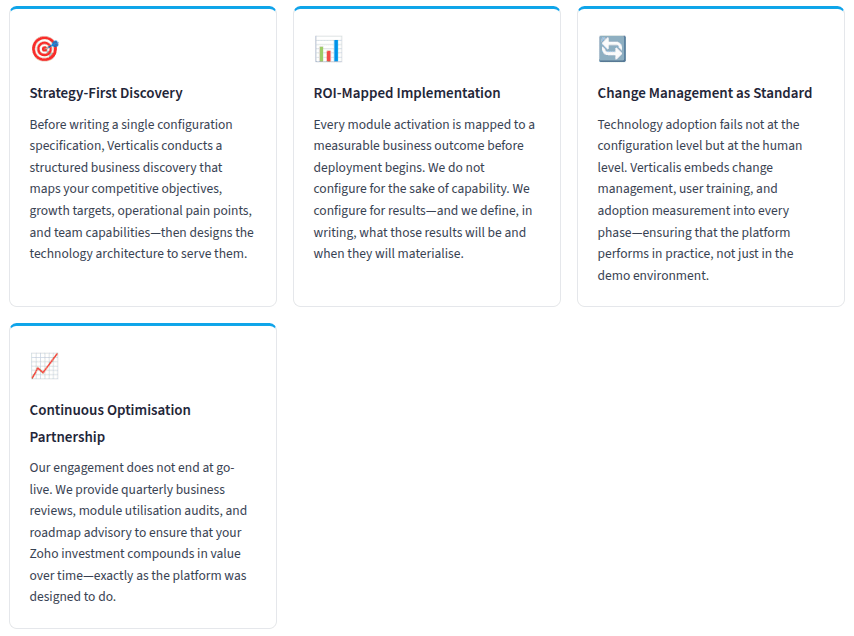
At Verticalis, we have built our practice around a fundamental philosophical inversion that distinguishes us from every technology-first consultancy in the market. We call it the Managerial-Techno approach—and the distinction is not cosmetic.
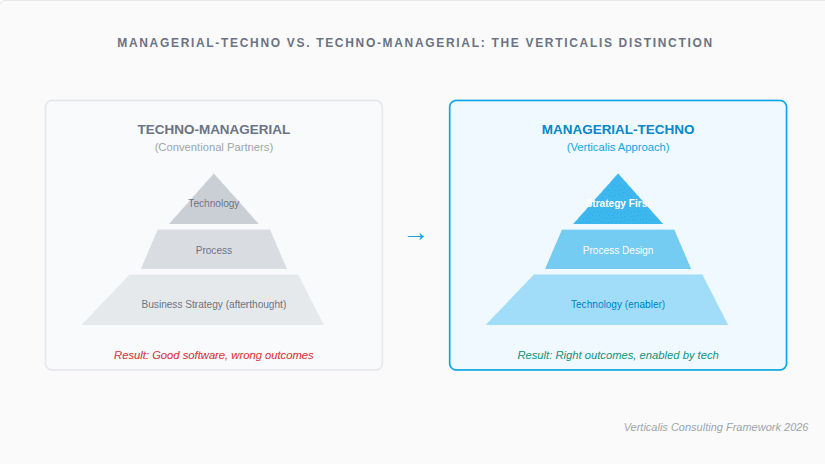
A techno-managerial consultant asks: "which Zoho modules are right for your industry?" A Verticalis consultant asks: "what does your business need to achieve in the next 36 months, and how do we architect a technology foundation that makes those outcomes inevitable?"
This distinction produces different conversations, different configurations, and dramatically different outcomes. Our clients do not receive a technology deployment. They receive a business transformation roadmap—where every workflow, every integration, every automation is designed to serve a defined strategic objective.
Conclusion: Invest Once, Profit Always
The headline conclusion of everything I have presented above is simple, but it is a conclusion that will define the competitive position of every Indian business in the next decade:
The businesses that will lead their industries in 2030 are not the ones that spent the least on technology in 2025 and 2026. They are the ones that invested in a unified, intelligent, scalable business operating system—and deployed it with a strategy-first partner who understood that the goal was never to install software, but to build a machine.
— Hiren Joshi, CXO, Verticalis Pvt. Ltd.
Zoho ERP and Zoho One represent, in my considered professional opinion, the single most compelling technology investment available to Indian growth-stage enterprises today. At ₹1,500/user/month, no comparable platform delivers 45+ applications, native AI intelligence, enterprise-grade security, and a proven 439% ROI track record.
The choice between Zoho One and a collection of cheaper, function-specific tools is not a choice between expensive and affordable. It is a choice between a compounding asset and a depreciating cost. It is the difference between building a foundation and renting quicksand.
At Verticalis, we bring the Managerial-Techno framework—strategy first, technology second—to every engagement. We do not simply deploy Zoho. We architect the conditions under which your business will outperform its competition, your teams will work at their highest capability, and your leadership will have the clarity of insight that only a truly unified system can provide.
The question is not whether Zoho One is the right platform. The evidence answers that question unambiguously. The question is whether your organisation is ready to make a long-term decision that will deliver short-term, medium-term, and long-term returns simultaneously—and whether you have the right partner to navigate that journey.
We invite you to find out.

