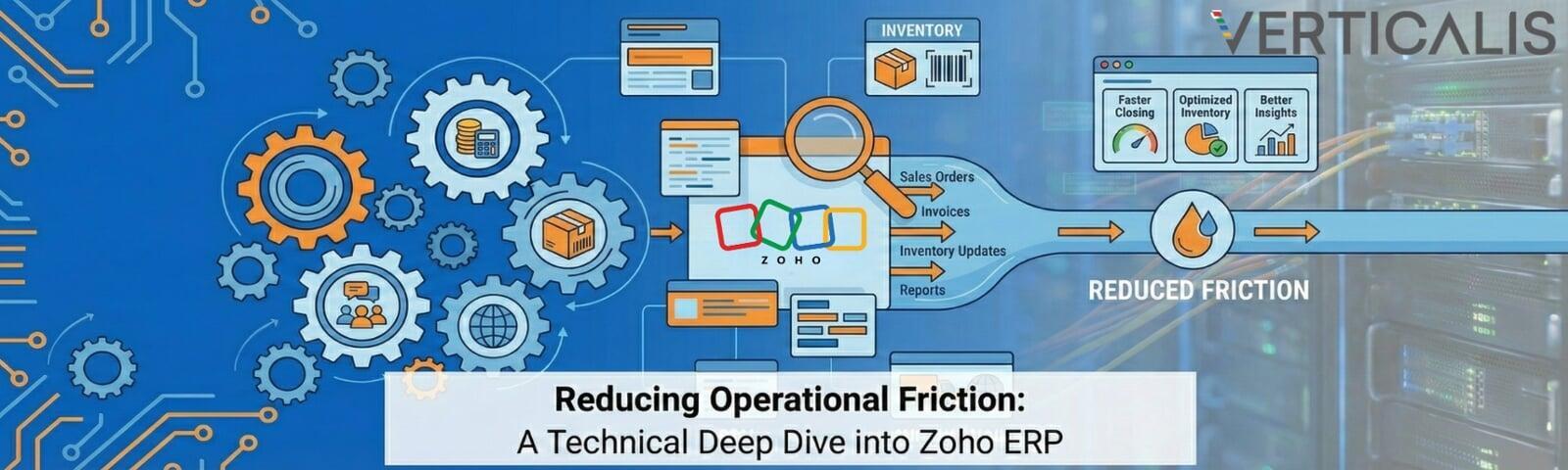
Enterprise Resource Planning today is no longer just “finance + inventory.” Modern ERP must be a modular, API-first, secure, low-code platform with embedded intelligence, easy integrations, and predictable TCO. Zoho’s evolution from a suite of best-in-class cloud apps into a coherent ERP stack (branded as Zoho ERP ) meets those technical requirements in ways that give it a practical edge versus many peers. Below I make a technical case — architecture, integration, development, security, AI, and economics — and then summarise those advantages in a compact evaluation table.
1. Unified full-stack design with fewer integration seams
Technically, one of the biggest causes of ERP failure (late projects, data duplication, long-term maintenance cost) is brittle cross-product integrations. Zoho’s ERP strategy is a suite-first approach: a set of stand-alone products that are designed to work together under a single identity, single-sign-on, centralized admin, and shared data model where appropriate. That reduces the number of bespoke middleware pieces and point-to-point ETL jobs teams must maintain. The result: lower operational complexity and faster rollout for process flows that spa; CRM → Inventory → Finance → HR.
Fewer API orchestration layers, smaller integration surface area, deterministic data lineage in ZOHO ERP materially lowers runtime failures and debugging effort.
2. API-first + low-code extensibility- Speed without vendor lock
Zoho provides REST-full APIs, a mature low-code platform (Zoho Creator) and Deluge scripting that lets implementers extend or add lightweight micro-apps inside the same platform. That combination is important technically: for complex or industry-specific rules you can either (a) implement within Creator/Deluge (low-latency, single-tenant logical extension) or (b) call Zoho’s APIs from external systems — both supported with OAuth 2.0 and production-grade API semantics. This hybrid extensibility avoids heavy customizations inside core modules (which hurt upgrades) while still enabling deep process automation.
3. Embedded, contextual AI — An operational intelligence rather than bolt-ons
Zoho’s AI (Zia) is embedded across modules to provide forecasting, anomaly detection, NLP-driven assistants and content generation. Because the intelligence sits inside the same data fabric, it can produce contextual, cross-module insights (for example: finance + sales + inventory signals combined for predictive cashflow alerts) without expensive data pipelines into a third-party AI service. That reduces latency and preserves data governance under the vendor’s DPA/Trust framework.
4. Security, compliance, and hosting controls
Zoho publishes ISO and SOC certifications, GDPR-ready controls, encryption in transit and at rest, and country-level data residency choices for many services. For enterprises with compliance requirements this is crucial: certifications and data-center controls remove a major blocker that would otherwise mandate expensive on-premises alternatives. Zoho also documents encryption, access controls, and third-party assessment processes. ZOHO complies with the provisions of The Digital Personal Data Protection (DPDP) Act 2023 and Rules, 2025.
5. Modularity reduces TCO and deployment risk
Compared to monolithic ERP systems that require “big-bang” deployments, Zoho’s modular stack lets organisations incrementally adopt modules (start with finance + inventory, then add HR and support) while keeping a consistent data model and single tenant admin. From an engineering standpoint this makes iteration safe: rollbacks are local, upgrades are incremental, and testing windows are smaller. Pricing and license structures also position Zoho as cost-efficient for small to mid-market customers. Comparative market reviews show Zoho’s compelling price-vs-feature ratio for SMBs and growing enterprises.
6. Localisation, integrations and ecosystem
Zoho maintains modules that are regionally localized (taxation, multi-currency, multi-warehouse) and provides built-in connectors and marketplaces for e-commerce, payment, and logistics partners. For businesses operating across jurisdictions this reduces the need to build country-specific adapters. Zoho’s recent fintech and payment integrations (country-specific) further tighten finance-to-collections workflows.
7. ERP evaluation parameters
Evaluation Parameter | Why it Matters | Zoho ERP Position vs Peers |
|---|
|
|
|
|
|
|
|
|
|
Architecture | Cohesive suite reduces integration
seams and data duplication. | Suite-first full-stack with single admin and shared services
ZOHO’s Position: Strong. |
|
|
|
|
|
|
|
|
|
API & Integration | API-first design, OAuth2, prebuilt
connectors reduce custom middleware. | Rich REST APIs + Integration builder + marketplace
ZOHO’s Position: Strong. |
|
|
|
|
|
|
|
|
|
Extensibility / Low-code | Ability to add business logic without
heavy custom code reduces upgrade risk. | Zoho Creator + Deluge offers productive low-code and on-prem options.
ZOHO’s Position: Strong. |
|
|
|
|
|
|
|
|
|
Embedded AI / Analytics | Real-time operational insights
when AI is native to platform. | Zia provides contextual AI across modules — lower data movement ZOHO’s Position: Edge. |
|
|
|
|
|
|
|
|
|
Security & Compliance | Certifications and data residency
reduce audit and legal friction. | ISO/SOC/GDPR coverage and Trust pages; data center choices .
ZOHO’s Position: Strong. |
|
|
|
|
|
|
|
|
|
Localization & Finance features | Accurate local taxes, GST/VAT, collections, POS integrations required for regional ops. | Built-in regional features + fintech integrations
ZOHO’s Position: Good |
|
|
|
|
|
|
|
|
|
Scalability & Performance | Ability to handle growing transaction volumes and concurrent users. | Cloud-native horizontally scalable architecture
ZOHO’s Position: Good for SMB→mid-market. |
|
|
|
|
|
|
|
|
|
Total Cost of Ownership | Licensing + implementation + maintenance = real business cost. | Typically lower initial and ongoing costs vs large enterprise ERPs; modular licensing helps
ZOHO’s Position: Advantage for SMBs. |
|
|
|
|
|
|
|
|
|
Ecosystem & Support | Third-party apps, partners, implementation skill availability. | Growing partner ecosystem and marketplace; active community ZOHO’s Position: Improving. |
In nutshell, Zoho shows clear technical strengths around suite integration, low-code extensibility, embedded AI, and compliance. These combine to lower engineering and operational friction versus many peers, especially for SMBs and fast-scaling organisations
8. Verticalis Business Solution – Your Trusted Global ERP implementation partner.
Verticalis Business Solution, Gandhinagar, is well-positioned to advise and implement Zoho ERP. Their team brings deep ERP consulting experience and a focus on Zoho deployments, which is critical because the vendor-partner fit determines how the technical advantages above are realised in production. Verticalis can run the architecture decisions, data migration, DevOps for integrations, and governance steps required for a robust implementation.
Sources:
1. Zoho One — The Operating System for Business.
2. Zoho ERP (Zoho India product page) — “A new era of ERP software from Zoho”.
3. Zia — Zoho’s AI assistant (capabilities and embedding across apps).
4. Zoho Creator API & Integration Builder documentation (API v2.1, JS API, Deluge).
5. Zoho Trust / Compliance pages (ISO, SOC, GDPR, data residency).
6. Zoho One vs Odoo comparison (Zoho PDF).
7. Capterra / market comparisons showing pricing/ratings vs S*P/N*tSu*te (summary market data).
8. News: Zoho fintech & payments integrations (India coverage).